

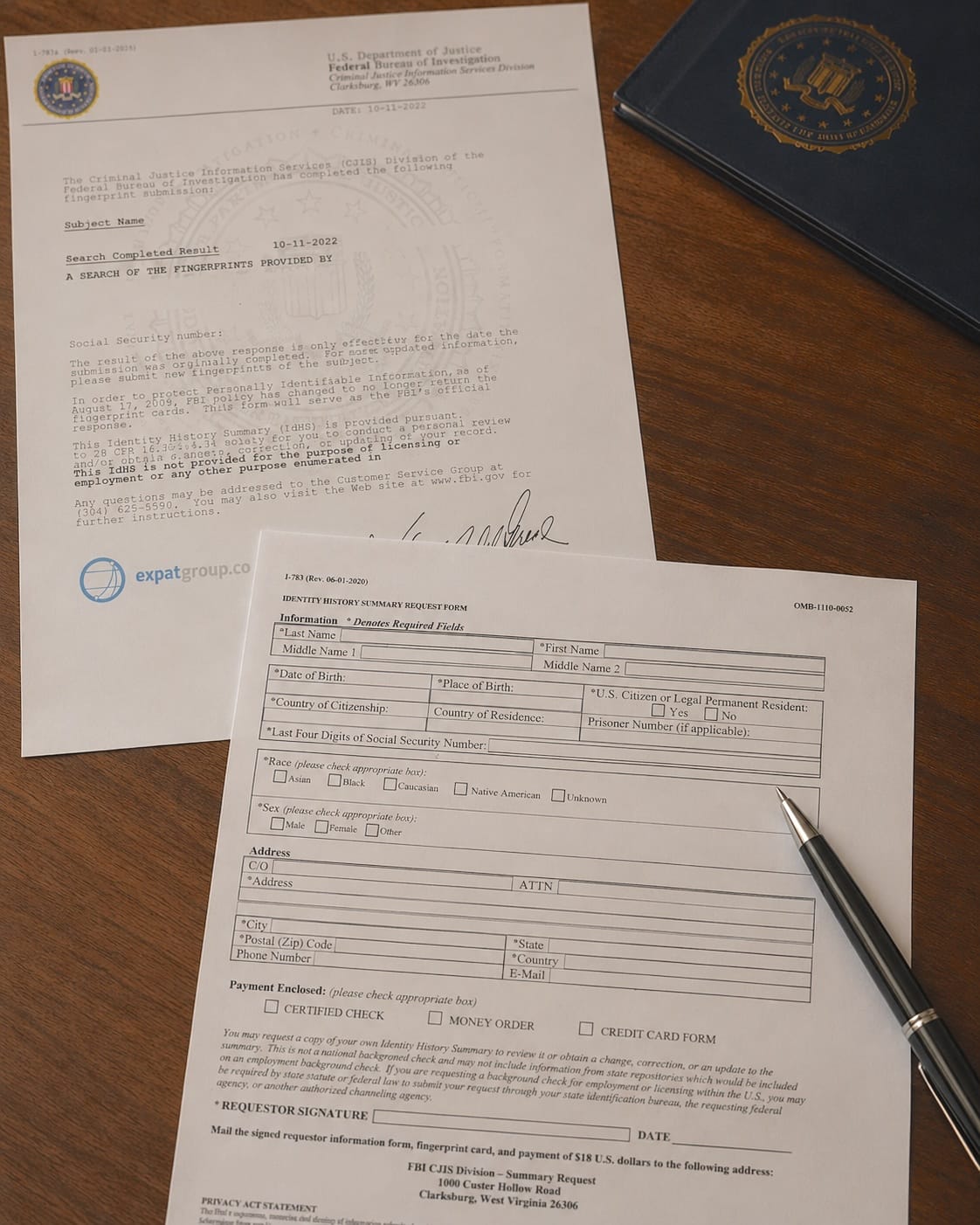
Apostille Your FBI Background Check
FBI Identity History Summary apostilles are processed by the U.S. Department of State in Washington D.C. — not California’s Secretary of State. We coordinate the federal filing from our San Francisco office so you don’t have to navigate the federal process alone.
- You have an FBI Identity History Summary (the official letter from the FBI CJIS Division or via FBI.gov)
- A foreign employer, immigration authority, or visa agency requires it apostilled for use abroad
- The destination country is a member of the 1961 Hague Convention
What You Need to Submit
Gather these before submitting. We verify each item during the $45 Document Check.
FBI Identity History Summary
Must be the official letter issued by the FBI Criminal Justice Information Services (CJIS) Division. Obtain it via FBI.gov → Identity History Summary Checks. Processing by FBI takes 2–4 weeks — request it early.
DOJ Channeler Letter (If Applicable)
If you obtained your background check through an FBI-approved channeler (Fieldprint, Identogo, etc.), include the channeler’s cover letter with the FBI summary. Some foreign consulates require it.
Destination Country & Purpose
Different countries require different formatting. Employment visas, residency permits, and teaching credentials each have distinct consulate requirements. Specify the destination country and your visa or permit type.
Payment
$350 flat for the FBI Background Check apostille. The $45 Document Check is credited toward your service. Courier charges to Washington D.C. are included.
Price & Turnaround
What’s Included
Document Verification
We confirm your FBI summary is the correct CJIS format and hasn’t expired for your destination country’s requirements before we file anything.
Federal Filing
We ship your document to the U.S. Department of State Authentications Office in Washington D.C. via tracked overnight courier and monitor processing status.
Return Shipping
USPS Priority or FedEx return included once the U.S. Dept of State issues the apostille. International courier to your destination country available on request.
- Verification that your FBI summary is in CJIS format (apostille-eligible)
- Overnight courier to U.S. Department of State Authentications Office, D.C.
- Processing status updates via email or text
- Return Priority shipping once apostille is issued
- Destination country requirement verification
- Guidance if FBI summary needs reissuance (format issues)
How Your FBI Background Check Apostille Gets Filed
-
Document Check
Submit your FBI Identity History Summary. We verify it is the correct CJIS format and meets your destination country’s specific requirements within 24 hours.
-
Federal Filing
We courier your document overnight to the U.S. Department of State Authentications Office in Washington D.C. — not Sacramento. Federal apostilles only process through D.C.
-
DOT Processing
The U.S. Department of State Authentications Office attaches the apostille. Standard processing: 10–15 business days. Rush service available when the DOT allows it.
-
Returned to You
The apostilled FBI summary is shipped back by USPS Priority or FedEx, or forwarded internationally if you need delivery directly to a foreign consulate or employer.
FBI Background Check Apostille — Common Questions
Why does an FBI background check go to Washington D.C. instead of Sacramento?
FBI background checks are federal documents — they carry a federal (CJIS Division) signature, not a California state signature. The California Secretary of State can only apostille documents with registered California signatures. Federal documents must go through the U.S. Department of State Authentications Office in Washington D.C., which is the designated federal apostille authority under the 1961 Hague Convention.
How do I get the FBI Identity History Summary before I can apostille it?
Request it at FBI.gov → Identity History Summary Checks. You can submit fingerprints by mail or through an FBI-approved channeler (Fieldprint, Identogo). Processing by the FBI takes 2–4 weeks — factor this into your total timeline alongside the 10–15 days for the apostille. Start early.
My California DOJ Live Scan results came back. Can I apostille those?
Not with a federal apostille. California DOJ results are state documents, not FBI documents. Many foreign countries specifically require the FBI Identity History Summary (federal), not a state DOJ result. If a foreign employer says “apostilled background check,” they almost always mean the FBI summary. Confirm with the requesting party before ordering any document.
Does the FBI background check expire for apostille purposes?
The FBI does not put an expiration date on the Identity History Summary itself. However, foreign governments and employers often impose their own currency requirements — typically requiring the background check be issued within 3 to 12 months of your visa or permit application. Check your specific destination country's requirements before requesting the FBI summary.
Which countries require an apostilled FBI background check?
Common requirements include: Mexico, Spain, Italy, Portugal, Germany, South Korea, Taiwan, Brazil, Argentina, Chile, Colombia, and the UAE for employment visas, residency permits, and teaching or healthcare credentials. Some countries (Saudi Arabia, Qatar) are not Hague members and require embassy legalization instead of an apostille. We verify the correct path for your destination.
Can you send the apostilled FBI background check directly to a foreign consulate or employer?
Yes. We offer international courier service from our San Francisco office. Once the U.S. Department of State returns the apostilled document to us, we can forward it directly to your foreign destination. Mention this requirement when you submit — we'll include a courier quote alongside the apostille fee.