Apostille Your California Birth Certificate
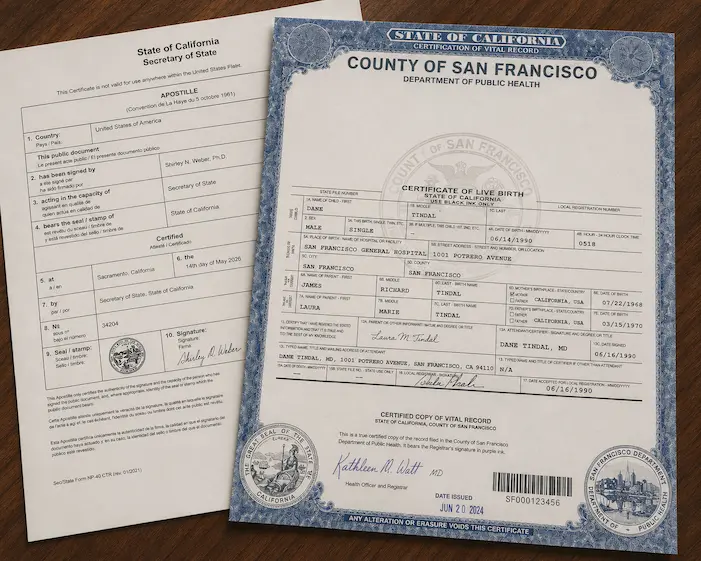
We handle California-issued birth certificates for use in any of the 125+ Hague Convention countries. Mail us your certified copy and we file directly with the California Secretary of State.
- Your birth certificate was issued in California (CDPH or county registrar)
- You need it accepted by a foreign government, employer, school, or court
- The destination country is a member of the 1961 Hague Convention
What You Need to Submit
Gather these before submitting. We verify each item during the $45 Document Check.
Certified Copy — Not a Photocopy
Must be an official certified copy from CDPH or a county recorder, not a hospital-issued souvenir certificate. The SOS only apostilles documents with an original government seal.
Destination Country
Tell us where the apostille will be used. Some countries require specific language notations or specific certificate editions. We verify during the $45 Document Check.
Your Full Name & Return Address
Exactly as it should appear on shipping labels. We use USPS Priority or FedEx — your choice. International courier available separately.
Payment
$175 for standard mail-in apostille service. Credited $45 if you complete the Document Check first. No surprise fees.
Price & Turnaround
What’s Included
Document Review
We verify your certificate format, issuing county, and signature before filing. Pre-2005 certificates checked for county certification requirements.
SOS Filing
We courier your document to the California Secretary of State Apostille Unit in Sacramento and track it through processing.
Return Shipping
USPS Priority return included. FedEx Overnight available on request. International courier to your destination country available at additional cost.
- Certified delivery to California SOS Sacramento office
- Processing status updates via email or text
- Return USPS Priority shipping included
- Pre-flight document check (catches rejections before filing)
- Hague destination country verification
- Assistance if rejected — refiling at no additional courier charge
How Your Birth Certificate Apostille Gets Filed
-
Submit & Check
Mail us your certified birth certificate copy. We run a $45 Document Check and confirm it’s SOS-eligible within 24 hours.
-
SOS Filing
We courier your document to the California SOS Apostille Unit in Sacramento the same day we confirm eligibility.
-
SOS Processing
The California Secretary of State attaches the apostille certificate — typically 5–7 business days from filing.
-
Returned to You
We ship the apostilled document back to you by USPS Priority Mail, or directly to your destination if you need international delivery.
Birth Certificate Apostille — Common Questions
Can I use a hospital-issued birth certificate for an apostille?
No. The California Secretary of State only apostilles documents bearing an official government seal and authorized signature. Hospital-issued birth certificates (souvenir copies) are not acceptable. You need a certified copy from the California Department of Public Health (CDPH) or the county recorder where the birth was registered.
What's the difference between a short-form and long-form birth certificate for apostille?
Both are accepted by the California SOS as long as they are certified copies from CDPH or a county recorder with an original raised or colored seal. Long-form certificates include more parental information and are often required for immigration, dual citizenship, and some European countries. When in doubt, use the long-form.
How do I get a certified copy of my California birth certificate?
Order directly from CDPH VitalChek (7–15 business days by mail) or visit your county recorder's office in person (same day in some counties). You can also order through VitalChek.com. The certified copy must be recent — some destination countries require it issued within the last 6–12 months.
My birth certificate is from before 2005. Will it work?
Pre-2005 certificates may carry a county recorder signature rather than a CDPH signature. Some can be apostilled directly; others require an additional county certification before the SOS will process them. Flag this during your $45 Document Check — we'll confirm eligibility before you mail anything.
Which countries require an apostilled birth certificate?
Most countries in Europe (Germany, France, Italy, Spain, Portugal), Latin America (Mexico, Brazil, Argentina, Colombia), Asia (China, Japan, South Korea, Philippines), and others request an apostilled birth certificate for immigration, marriage registration, dual citizenship, or school enrollment. We confirm the specific requirements for your destination country during the Document Check.
Can you send the apostilled birth certificate directly to another country?
Yes. We offer international courier service from our San Francisco office directly to your destination. Pricing depends on country and carrier. Let us know your destination when you submit — we'll quote a courier fee alongside the apostille fee.